
The Coffee Curve
Initially published July 16, 2026
Four Cups
I drink about four coffees a day, all of them between 8 AM and 3 PM. For a habit that large, I wanted to know whether I was spending health or buying it.
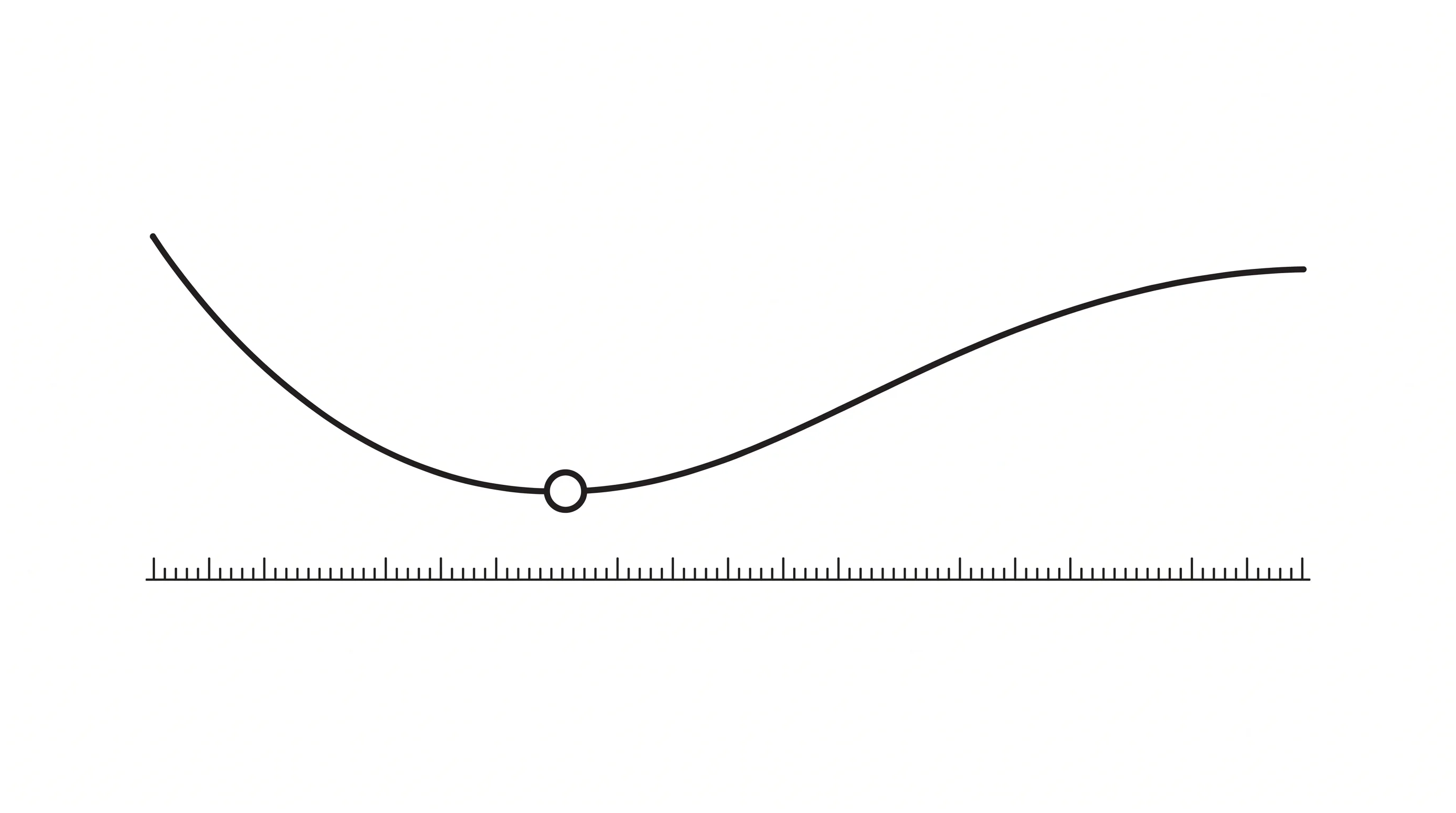
The reassuring news comes first, because it is the strongest evidence in the whole field. Pool hundreds of studies together, as a 2017 umbrella review did, and coffee traces a J-curve against mortality: risk falls as intake rises, bottoms out around three to four cups a day, and only ticks back up well beyond that. At the bottom of the curve, all-cause mortality runs about 17% lower and cardiovascular mortality about 19% lower than for non-drinkers. Four cups sits right at the floor.

It is association, not proof. Coffee drinkers differ from abstainers in a hundred uncontrolled ways. But the signal is unusually consistent, and it points the same direction across populations. If anything about coffee is close to settled, it is this.
The Diuretic Myth
The most durable piece of coffee folklore is that it dehydrates you, that every cup owes a glass of water. It does not, at the doses habitual drinkers actually consume.
When researchers gave regular coffee drinkers four cups a day and compared them against the same volume of water, there was no difference in total body water or any marker of hydration. Coffee’s beverage hydration index, how much fluid it retains against plain water, comes out at essentially one. There is a mild diuretic nudge from caffeine, real but small, and in a habituated body it is swamped by the water the coffee is dissolved in.
The cup counts toward your fluids. It does not owe them.
Sleep and the Half-Life
Caffeine’s real cost is paid at night, and it is a question of clearance. The half-life is five to seven hours, which means a mid-afternoon dose is still meaningfully present at bedtime. The mechanism is blunt: caffeine sits on the receptors adenosine uses to signal sleep pressure, so it does not just delay sleep, it degrades it.
The one controlled timing study is sobering. Four hundred milligrams taken six hours before bed still cut total sleep by about 40 minutes, and the subjects often did not notice. That is the evidence behind the “no coffee after 3 PM” rule, and it is directionally right but numerically loose: the study tested six hours, not the eight-plus that separates a 3 PM cup from an 11 PM bedtime.

My cutoff is defensible, but I hold it as a heuristic, not a proof. If sleep frays, the lever is to move the cutoff earlier, not to trust the clock I inherited.
I track this more closely than most: an Oura ring, a Whoop band, and an Eight Sleep. My sleep is about as dialed as I can get it, and the data points somewhere the caffeine studies do not. Both my last cup and my last meal land around 3 PM, and of the two, the meal is the lever. Eating once a day and closing that window by mid-afternoon does more for how I sleep than cutting an afternoon coffee ever has. Caffeine is the variable everyone polices. For me, a late meal is the one that costs a night.
Pressure and Glucose
Two more objections deserve honest handling.
Blood pressure: caffeine acutely raises it, around 8 mmHg systolic in someone who rarely drinks it. But tolerance sets in within days, and habitual drinkers show a much smaller response, with only a modest residual effect on chronic pressure. Set against the mortality curve, it does not move the ledger for a regular drinker.
Glucose is the sharper paradox. Acutely, caffeine blunts insulin sensitivity: a single dose measurably worsens the glucose response. Yet habitual coffee, across large cohorts, tracks with lower type-2 diabetes risk. The resolution is that the protection is not the caffeine. Decaffeinated coffee shows nearly the same mortality and metabolic benefit, which points at the polyphenols (chlorogenic acids and their relatives) as the active ingredients. Caffeine may carry a small acute metabolic cost that the rest of the bean more than repays over years.
The Genetics Everyone Gets Wrong
Here is where the internet loses the thread, and where I had to correct myself.
There is a well-known study showing that people who metabolize caffeine slowly, drinking four or more cups a day, had a 64% higher odds of a non-fatal heart attack, while fast metabolizers had no excess risk at all. It is a real result, and it launched a thousand “know your CYP1A2” posts. What those posts omit is the sequel: a UK Biobank analysis of 347,000 people found no interaction between coffee, that gene, and cardiovascular disease at all. One retrospective case-control study, contradicted by a cohort three orders of magnitude larger, is not a rule to run your life on.
I have two genetic readouts of my own, and together they taught me a second lesson about reading these things. The packaged caffeine report only estimates how much I tend to drink, slightly below average, from consumption markers. It never touches rs762551, the metabolizer variant the heart-attack study hinged on. The raw data does. I searched the gene, scrolled past the consumption markers, and there it was.
I am A/A at rs762551, the genotype usually called a rapid metabolizer, and the exact group that showed no excess heart-attack risk at four or more cups in the original study. So the one time the genetics could flatter my habit, they do. I still will not lean on it. The interaction that reading rests on did not survive the larger cohort, and a single position does not set how fast you clear caffeine, which smoking, medication, and the rest of the genome all bend. It is a reassuring footnote, not a verdict.

The Cup Itself
The variable actually worth minding is the brew. Coffee’s oils carry diterpenes (cafestol and kahweol) that raise LDL cholesterol. A paper filter traps most of them. A French press or boiled coffee lets them straight through, and the lipid effect of unfiltered coffee is well documented. Across a large cohort, filtered coffee tracked with lower mortality than unfiltered, though unfiltered was not outright harmful.
I run a Nespresso machine, which sits in the middle: capsule espresso carries far fewer diterpenes per cup than a French press, well below the level that moves lipids much at four small shots. If my LDL ever argued otherwise, the brew is the cheapest lever to pull. For now it is a non-issue I am glad I checked.
One more correction while I am at it: the famous 400-milligram-a-day ceiling is the European food-safety authority’s number, not the FDA’s, as it is usually cited. The FDA has never set a daily cap. Four cups keeps me under it either way.
The Audit
So I audited four cups a day against the evidence, expecting to find a habit to trim, and found instead a habit to keep. It sits at the bottom of the mortality curve. It counts toward my water. It does not, at these doses and this brew, threaten my pressure, my glucose, or my lipids. The one real cost is sleep, and I pay it forward by front-loading the day and stopping in the early afternoon.
I changed nothing. The point was never to change something. It was to know which parts of the ritual are load-bearing and which are folklore. Four cups, before three, filtered by the capsule, cut off in time to sleep. Audited, and kept.
References
Poole, R. et al. (2017). Coffee Consumption and Health: Umbrella Review.
BMJ: three to four cups a day was associated with the largest reductions in all-cause and cardiovascular mortality.
Loftfield, E. et al. (2018). Coffee Drinking and Mortality in the UK Biobank.
JAMA Internal Medicine: decaffeinated coffee showed a mortality benefit close to caffeinated, pointing away from caffeine as the active agent.
Killer, S. et al. (2014). No Evidence of Dehydration With Moderate Coffee Intake.
PLOS ONE: four cups a day produced no difference in total body water or hydration markers versus the same volume of water.
Maughan, R. et al. (2016). A Randomized Trial to Assess the Beverage Hydration Index.
American Journal of Clinical Nutrition: coffee retained fluid about as well as water, with a hydration index near one.
Drake, C. et al. (2013). Caffeine Effects on Sleep Taken 0, 3, or 6 Hours Before Bed.
Journal of Clinical Sleep Medicine: 400 mg taken even six hours before bed measurably reduced total sleep time.
Cornelis, M. et al. (2006). Coffee, CYP1A2 Genotype, and Risk of Myocardial Infarction.
JAMA: a case-control study where slow caffeine metabolizers drinking four or more cups a day had higher odds of a heart attack.
Zhou, A. & Hyppönen, E. (2019). Habitual Coffee, CYP1A2, and Cardiovascular Disease.
American Journal of Clinical Nutrition: no coffee-by-CYP1A2 interaction across 347,000 UK Biobank participants.
Tverdal, A. et al. (2020). Coffee Brewing Method and Mortality.
European Journal of Preventive Cardiology: filtered coffee tracked with lower mortality than unfiltered, which carries LDL-raising diterpenes.
EFSA Panel (2015). Scientific Opinion on the Safety of Caffeine.
EFSA Journal: habitual intake up to 400 mg a day does not raise safety concerns for healthy non-pregnant adults.
Dindin, M. (2026). Eating Once a Day.
The one-meal-a-day protocol behind the sleep note: closing the eating window by mid-afternoon does more for my sleep than any caffeine cutoff.