Reshaped
The story behind the tattoo
When I decided to get a tattoo, I did not want an image I would grow out of. I wanted a thesis I would still defend in fifty years, so I spent far longer on the story than on the drawing.
I had circled the idea for years. Almost everyone in my family is tattooed by now, my mother the last holdout, so the question was never whether but what. I refused to commit a single line until the meaning behind it was settled.
The piece covers my upper back, inside a circle. I am color-blind, so color was never on the table. The constraint became the aesthetic: black and shades of grey, nothing else. Working inside a limit tends to produce a cleaner idea than working without one.
The idea I borrowed
The spine of the piece comes from Jujutsu Kaisen, where Mahito asks one question: does the soul come before the body, or the body before the soul? He separates the two and reshapes the body at will. I am not interested in the supernatural framing, only the claim underneath it: the body is not fixed, it is material we can understand and eventually edit.
That is the whole of my work. Longevity is not a wish for more time. It is the practice of treating biology as something we can read, model, and reshape.
Where it sits
I wanted the tattoo confined to the upper back, stopping at the line of the shoulders and never running past the ribs. One circle, read as a whole before it is read in parts.
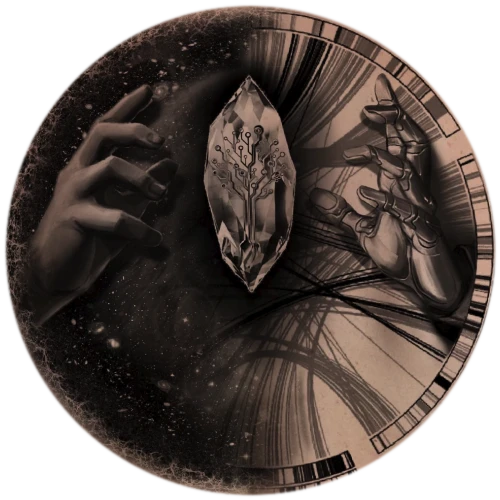
The background is built from concentric layers of contrast. A dark core holds the crystal, a lighter ring surrounds it, a darker ring sits beyond that, and the outer edge falls back to dark before it dissolves into skin. Two halves face each other across that core, and the whole point is how they resolve.
Two forces, one crystal
The composition sets two forces against each other and resolves them in the middle.
On one side is nature. A human hand reaches in from a field of galaxies, drawn at the logarithmic scale of the known universe, the map made at Princeton that Yusuke Murata later borrowed for One Punch Man as God's eye. It is the world we came from, the part of us that was not designed.
On the other side is technology. A bionic hand reaches in from an arc of the human genome, compared across species and rendered as sequencing bars. It is the world we build, the part of us we are learning to author.
Between the two hands sits a crystal, shattering at its base. Inside it grows a tree drawn as a circuit board: nature written in the language of technology. The two hands are not fighting over the crystal. They are shaping it together. That is the argument of the tattoo, and of the work. Biology and technology are converging on the same object, which is life itself.
The six components
Read on its own, the circle breaks into six parts.
The universe: the left half, a log-scale map of everything we can see. The genome: the right half, our code compared across species.
The human hand: nature and inheritance, what we did not choose. The bionic hand: human creativity expressed as machinery, what we build.
The crystal: the vessel where the two forces meet, breaking and reforming. The circuit-tree inside it: life encoded as technology, the fusion made visible.
From concept to skin
None of this arrived finished. It began as manga panels, a log-scale poster, and a stack of reference sketches for two hands I could not yet place. Early mockups even had the genome and the universe on the sides opposite to where they ended up, until it was obvious the human hand belonged with the galaxies and the machine with the sequencing bars.
From there it took rough composites, a session tracing the whole thing onto my back in grey, and then the ink itself to settle the balance. What started as borrowed images is now a single argument I carry between my shoulders.