
The Two-Hour Stand
Initially published October 15, 2026
The ache that keeps returning
My lower back has hurt on and off for as long as I can remember. The pain never stays long, and it never leaves for good. On many nights I spend fifteen minutes on the floor, twelve positions for thirty seconds each. That routine has helped my back, but not reliably, and the pain keeps coming back.
Most of the rest of my day happens at a desk, so I researched office chairs, ordered an Autonomous ErgoChair Pro in August 2026, and it helped. A standing desk helped as well. Then I went lower. The muscles of the lower back anchor on the pelvis, and the pelvis rides on the hips and legs, so a back problem can start below the waist. In the mirror, in profile, my pelvis looks tipped forward, and I now correct it on purpose.
What sitting costs
Long hours of sitting track with worse health long before they reach the back. In a pooled analysis of 16 cohorts, people who sat over eight hours a day and moved the least were 59% more likely to die during follow-up than people who sat under four hours and moved the most. The excess shrank with activity: among the most active quarter, about an hour of moderate exercise a day, heavy sitting carried no clear extra risk, although long evenings of television still did. Pooled across studies, the risk climbs slowly at first and more steeply past six to eight hours a day, bends fitted to the data rather than safe limits.
The blood markers respond within a single afternoon. In a laboratory crossover of overweight adults, a two-minute walk every twenty minutes cut the rise in blood sugar after a test meal by about a quarter and insulin by about the same, against sitting straight through. Pooled across trials, standing breaks lowered blood sugar only slightly and left insulin unchanged; walking breaks did clearly better on both.
Back pain is where the link weakens. Studies that followed people forward found no connection between sitting time and developing lower back pain. Snapshot studies that measure sitting with accelerometers do find one, but pain also keeps people still, so the direction can run either way.
What the furniture changes
A sit-stand desk cuts sitting time, though most of that evidence is low quality. A Cochrane review found workers sat about 100 fewer minutes per workday in the first three months, settling to about an hour later on. In the SMArT Work trial, office workers given a desk still sat 83 fewer minutes a day after a year.

A second Cochrane review could not show that standing or walking interventions at work reduce lower back pain; the two small sit-stand trials it pooled were compatible with a benefit and with none. SMArT Work found no overall difference in musculoskeletal problems after a year, though workers with desks were less likely to say back problems kept them from normal activities. People who stand more than four hours a workday also report more back pain, in mostly cross-sectional data. Neither a chair nor a desk has a trial behind it as a treatment for back pain.
A University of Waterloo lab tested the exercise ball as a chair. After an hour on a ball, people had more activity in their upper-back muscles, less pelvic tilt and more discomfort than on an office chair, and the authors concluded the ball may not help with long sitting. In a second study, muscle activity and spine load were the same on a ball and on a wooden stool, and in a reaching study people felt more at risk of falling off the ball. No trial has tested a ball against back pain. The closest is a trial in office workers at high risk of back pain, where a dynamic seat cushion cut new cases against a placebo pad but did not help people who already had pain.
The tilt in the mirror
A forward-tipped pelvis is the common case. In one study of healthy young adults, 85% of the men and 75% of the women tilted forward. Bone shape moves the number too: the landmarks used to measure tilt vary enough between pelves that two people standing the same way can read very differently.
Whether the tilt tracks pain is unproven. A large meta-analysis compared people with and without lower back pain. The curve of the lower back was the same in both groups. Standing pelvic tilt leaned slightly toward more tilt in people with pain, from only three studies, and the estimate includes zero.


Sitting does leave a measurable mark on the hips. People who were inactive and sat for long periods had about six degrees less passive hip extension than active people who sat little, although that comparison can’t separate sitting from inactivity.
In a squat, the pelvis tucks under at the bottom once hip flexion runs out, at the same hip angle with or without raised heels. Among runners, each extra degree of pelvic drop raised the odds of belonging to the injured group by about 80%. Both are associations.
The two-hour stand
Between 40% and 70% of people with no history of back pain develop it during two hours of standing. Jack Callaghan’s lab at the University of Waterloo has used prolonged standing for years as a way to make back pain appear on demand, and then to compare the people who hurt with the people who don’t.
In one of its studies, 17 of 24 participants developed pain. Those who hurt fired the gluteus medius, the muscle on the outside of each hip that holds the pelvis level over one leg, on both sides at once, and they held a side plank for less time. Hip-abduction strength fell by similar amounts in both groups and didn’t separate them. The side plank tests the trunk as much as the hip, so a later study measured hip-abductor force directly. Everyone lost force over two hours of standing; the people who developed pain lost it sooner and hadn’t recovered it by the end. The samples are small, and the co-activation could be a response to discomfort as easily as a cause.
The lab also followed its participants for three years. 35% of those who had developed pain while standing went on to report a clinical episode of lower back pain, against 23% of those who hadn’t.

People with lower back pain have weaker hip abductors and extensors than people without, though a snapshot comparison can’t say which came first. Across five trials, adding hip strengthening to back rehabilitation lowered pain by about five points on a 100-point scale. Another review rated the short-term evidence very low certainty and found no benefit at medium or long term.
My training doesn’t test this. Two strength sessions and one or two runs a week say nothing about how my hips hold up through hours at a desk. I’ve changed my stretching and added hip work at the gym.
A home set for the hips

Because endurance is what separated the people who hurt, I’d train these as controlled holds and long sets, stopping when form slips. The only dosing anchor I found is borrowed from knee-pain trials, about three sessions a week for four to six weeks. Stop any movement that reproduces your back pain, and see a clinician if the pain persists or spreads.
The six strength movements come from electromyography, which records how hard a muscle works as a share of a reference maximal effort. Five of the six were tested in the same people in one study, and all five worked the gluteal muscles at or above the 40 to 60% range a review of these studies treats as a strengthening stimulus. The clamshell, a common prescription for these muscles, scored below all five for the gluteus medius in its basic form.

Side plank with top-leg abduction
Both hips work: the top leg lifts while the bottom hip holds the pelvis off the floor. It is also the side-plank test from the standing study, so hold time on each side doubles as a self-test. Stack the hips and keep the bottom hip lifted as the top leg rises.
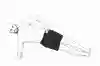
Plank with bent-leg hip extension
This produced the highest gluteus maximus reading in the study. Bending the knee takes the hamstrings out of the lift and leaves it to the glute. Raise the thigh without arching the lower back.
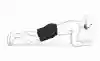
Single-leg squat to a chair
The gluteus maximus drives the stand while the gluteus medius keeps the pelvis level. Tap the chair lightly and keep the knee tracking over the foot.
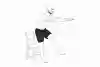
Single-leg Romanian deadlift
A hinge on one leg loads both gluteal muscles together. Hinge at the standing hip with the knee slightly soft, and reach the free leg back instead of rounding the back to go lower.
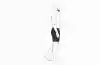
Split squat
It wasn’t in the same study; with a load, it reached about 70% of maximal gluteus maximus activity in another. Lower the back knee toward the floor and stand tall at the top without leaning back.
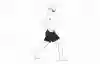
Single-leg bridge
The easiest here, at about half of a maximal effort for both gluteal muscles. Lift the pelvis as one unit, keep the hips level, and stop before the lower back supplies the extra height.
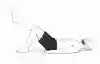
Half-kneeling hip-flexor stretch
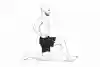
This targets the hip extension that long sitting is associated with losing. Tuck the pelvis first, then shift forward until the front of the kneeling hip takes the stretch. No trial shows that this stretch changes pelvic tilt or back pain; it is range work next to the strength work.
Beyond the home set
With a barbell, the deep squat has the most trial support I found. In trained men, full-depth squats raised strength at every depth, while half squats produced no gains and more pain. In untrained adults, the squat grew the glutes about as much as the hip thrust and added growth in the quadriceps and adductors. Pooled trials found that hip thrust gains did not carry over to squat strength or jumping, at low certainty. No randomized trial has compared the deadlift with another exercise on hip outcomes.
In young footballers, the Copenhagen plank, a side plank with the top leg resting on a bench, raised eccentric adductor strength by about a third in eight weeks. Side-lying leg raises built abductor strength in healthy adults with leg weight alone as well as with a heavier load.
Static stretching and PNF increase range of motion more than bouncing stretches, with no clear effect of how much, how hard or how often people stretch. Strength training matched stretching for range of motion in pooled trials. The popular drills have less behind them: 90/90 transitions and controlled hip rotations have no multi-week trial, and yoga and Pilates have only a few small, mixed trials with hip outcomes.
Endurance is the least studied quality: no trial in healthy adults has trained hip-abductor endurance and measured it.
The next working day
The test I can run on myself is the one the lab ran: how long I stay in one position before the ache shows up, and how long I hold a side plank on each side. I haven’t measured a durable change in my back yet. The plan is fewer hours in one position, and hips trained to last through the ones that remain.
Hope this gets to help others!
References
Ekelund, U. et al. (2016). Does Physical Activity Attenuate, Or Even Eliminate, The Detrimental Association Of Sitting Time With Mortality? A Harmonised Meta-Analysis Of Data From More Than 1 Million Men And Women.
Sixteen cohorts: 59% higher mortality for the most sedentary and least active, and no clear excess in the most active quarter. The Lancet.
Patterson, R. et al. (2018). Sedentary Behaviour And Risk Of All-Cause, Cardiovascular And Cancer Mortality, And Incident Type 2 Diabetes: A Systematic Review And Dose Response Meta-Analysis.
Risk per hour of sitting steepens past about six to eight hours a day. European Journal of Epidemiology.
Dunstan, D.W. et al. (2012). Breaking Up Prolonged Sitting Reduces Postprandial Glucose And Insulin Responses.
Two-minute walks every twenty minutes, and about a quarter less glucose and insulin after a test meal. Diabetes Care.
Buffey, A.J. et al. (2022). The Acute Effects Of Interrupting Prolonged Sitting Time In Adults With Standing And Light-Intensity Walking On Biomarkers Of Cardiometabolic Health In Adults: A Systematic Review And Meta-Analysis.
Standing breaks lowered glucose slightly; walking breaks did better on glucose and insulin. Sports Medicine.
Alzahrani, H. et al. (2022). The Association Between Sedentary Behavior And Low Back Pain In Adults: A Systematic Review And Meta-Analysis Of Longitudinal Studies.
No link between sitting time and developing low back pain in longitudinal studies. PeerJ.
Gupta, N. et al. (2015). Is Objectively Measured Sitting Time Associated With Low Back Pain? A Cross-Sectional Investigation In The NOMAD Study.
Accelerometer-measured sitting and back pain in 201 blue-collar workers, cross-sectional. PLOS ONE.
Gregory, D.E., Dunk, N.M. & Callaghan, J.P. (2006). Stability Ball Versus Office Chair: Comparison Of Muscle Activation And Lumbar Spine Posture During Prolonged Sitting.
An hour on a ball: more upper-back muscle activity and more discomfort than a chair. Human Factors.
McGill, S.M., Kavcic, N.S. & Harvey, E. (2006). Sitting On A Chair Or An Exercise Ball: Various Perspectives To Guide Decision Making.
No difference from a stool in muscle activity or spine load. Clinical Biomechanics.
Buchman-Pearle, J.M., Karakolis, T. & Callaghan, J.P. (2022). Does Sitting On A Stability Ball Increase Fall Risk During Ergonomic Reaching Tasks?
Higher perceived fall risk when reaching from a ball. Applied Ergonomics.
Channak, S. et al. (2024). The Effectiveness Of A Dynamic Seat Cushion In Preventing Neck And Low-Back Pain Among High-Risk Office Workers: A 6-Month Cluster-Randomized Controlled Trial.
Fewer new cases of back pain with the cushion; no help for existing pain. Scandinavian Journal of Work, Environment and Health.
Pallarés, J.G. et al. (2020). Full Squat Produces Greater Neuromuscular And Functional Adaptations And Lower Pain Than Partial Squats After Prolonged Resistance Training.
Ten weeks in trained men: full squats gained at every depth, half squats did not. European Journal of Sport Science.
Plotkin, D.L. et al. (2023). Hip Thrust And Back Squat Training Elicit Similar Gluteus Muscle Hypertrophy And Transfer Similarly To The Deadlift.
Similar glute growth, with extra quadriceps and adductor growth from the squat. Frontiers in Physiology.
Lin, S. et al. (2026). Acute And Long-Term Effects Of Hip Thrust Training On Athletic Performance: A Systematic Review And Meta-Analysis.
Hip thrust strength rose without carry-over to squats or jumps, at low certainty. PeerJ.
Ishøi, L. et al. (2016). Large Eccentric Strength Increase Using The Copenhagen Adduction Exercise In Football: A Randomized Controlled Trial.
About 36% more eccentric adductor strength in eight weeks. Scandinavian Journal of Medicine and Science in Sports.
Thorborg, K. et al. (2010). Hip Abduction Strength Training In The Clinical Setting: With Or Without External Loading?
11 to 23% more abductor strength in six weeks, loaded or not. Scandinavian Journal of Medicine and Science in Sports.
Konrad, A. et al. (2024). Chronic Effects Of Stretching On Range Of Motion With Consideration Of Potential Moderating Variables: A Systematic Review With Meta-Analysis.
Static and PNF stretching beat ballistic; dose did not moderate the gains. Journal of Sport and Health Science.
Afonso, J. et al. (2021). Strength Training Versus Stretching For Improving Range Of Motion: A Systematic Review And Meta-Analysis.
Eleven trials, no difference in range of motion gains. Healthcare.
Head, P.L. et al. (2026). Comparison Of Controlled Articular Rotations And Static Stretching On Hip Internal Rotation Range Of Motion.
A single session; both methods improved hip rotation equally. International Journal of Exercise Science.
Shrestha, N. et al. (2018). Workplace Interventions For Reducing Sitting At Work.
About 100 fewer minutes of sitting per workday with sit-stand desks, from low-quality evidence. Cochrane Database of Systematic Reviews.
Edwardson, C.L. et al. (2018). Effectiveness Of The Stand More AT (SMArT) Work Intervention: Cluster Randomised Controlled Trial.
83 fewer minutes of sitting per workday after a year, and no overall difference in musculoskeletal problems. BMJ.
Parry, S.P. et al. (2019). Workplace Interventions For Increasing Standing Or Walking For Decreasing Musculoskeletal Symptoms In Sedentary Workers.
Two small sit-stand trials, compatible with a benefit for back pain and with none. Cochrane Database of Systematic Reviews.
Coenen, P. et al. (2018). Associations Of Occupational Standing With Musculoskeletal Symptoms: A Systematic Review With Meta-Analysis.
More than four hours of standing a workday and low back symptoms, odds ratio 1.31, mostly cross-sectional. British Journal of Sports Medicine.
Herrington, L. (2011). Assessment Of The Degree Of Pelvic Tilt Within A Normal Asymptomatic Population.
Anterior tilt in 85% of men and 75% of women among 120 healthy young adults. Manual Therapy.
Preece, S.J. et al. (2008). Variation In Pelvic Morphology May Prevent The Identification Of Anterior Pelvic Tilt.
Thirty cadaver pelves and a landmark angle ranging from 0 to 23 degrees. Journal of Manual and Manipulative Therapy.
Laird, R.A. et al. (2014). Comparing Lumbo-Pelvic Kinematics In People With And Without Back Pain: A Systematic Review And Meta-Analysis.
No difference in lordosis, and an unproven lean toward more pelvic tilt with back pain. BMC Musculoskeletal Disorders.
Boukabache, A. et al. (2021). Prolonged Sitting And Physical Inactivity Are Associated With Limited Hip Extension: A Cross-Sectional Study.
About six degrees less passive hip extension in inactive people who sat for long periods. Musculoskeletal Science and Practice.
Mata, A.J. et al. (2021). Hip Flexion Angles During Supine Range Of Motion And Bodyweight Squats.
The pelvis tucked under at the same hip angle with and without raised heels. International Journal of Exercise Science.
Bramah, C. et al. (2018). Is There A Pathological Gait Associated With Common Soft Tissue Running Injuries?
Pelvic drop separated 72 injured runners from 36 uninjured ones in a cross-sectional comparison. The American Journal of Sports Medicine.
Nelson-Wong, E. et al. (2008). Gluteus Medius Muscle Activation Patterns As A Predictor Of Low Back Pain During Standing.
About 65% of pain-free adults developed back pain in two hours of standing. Clinical Biomechanics.
Marshall, P.W. et al. (2011). Gluteus Medius Strength, Endurance, And Co-Activation In The Development Of Low Back Pain During Prolonged Standing.
Seventeen of 24 developed pain; co-activation and side-plank endurance separated them, strength did not. Human Movement Science.
Viggiani, D. & Callaghan, J.P. (2018). Hip Abductor Fatigability And Recovery Are Related To The Development Of Low Back Pain During Prolonged Standing.
The people who developed pain fatigued sooner and had not recovered after two hours. Journal of Applied Biomechanics.
Nelson-Wong, E. & Callaghan, J.P. (2014). Transient Low Back Pain Development During Standing Predicts Future Clinical Low Back Pain In Previously Asymptomatic Individuals.
Three years of follow-up: 35% against 23%. Spine.
de Sousa, C.S. et al. (2019). Lower Limb Muscle Strength In Patients With Low Back Pain: A Systematic Review And Meta-Analysis.
Weaker hip abductors and extensors in people with low back pain, from case-control studies. Journal of Musculoskeletal and Neuronal Interactions.
de Jesus, F.L.A. et al. (2020). Addition Of Specific Hip Strengthening Exercises To Conventional Rehabilitation Therapy For Low Back Pain: A Systematic Review And Meta-Analysis.
Five trials and about five points less pain on a 100-point scale. Clinical Rehabilitation.
Ceballos-Laita, L. et al. (2023). The Effectiveness Of Hip Interventions In Patients With Low-Back Pain: A Systematic Review And Meta-Analysis.
Short-term benefit at very low certainty, none at medium or long term. Brazilian Journal of Physical Therapy.
Boren, K. et al. (2011). Electromyographic Analysis Of Gluteus Medius And Gluteus Maximus During Rehabilitation Exercises.
Twenty-two exercises ranked in the same participants, the source of the activation chart. International Journal of Sports Physical Therapy.
Distefano, L.J. et al. (2009). Gluteal Muscle Activation During Common Therapeutic Exercises.
Single-leg squat and single-leg deadlift among the highest gluteal readings. Journal of Orthopaedic and Sports Physical Therapy.
Neto, W.K. et al. (2020). Gluteus Maximus Activation During Common Strength And Hypertrophy Exercises: A Systematic Review.
Loaded exercises only; the split squat at about 70% from a single study. Journal of Sports Science and Medicine.
Macadam, P. & Feser, E.H. (2019). Examination Of Gluteus Maximus Electromyographic Excitation Associated With Dynamic Hip Extension During Body Weight Exercise: A Systematic Review.
Bodyweight hip extension, including bridge variations. International Journal of Sports Physical Therapy.
Dindin, M. (2026). Stretch to Sleep.
The nightly floor routine, and what stretching does and does not change.
Dindin, M. (2026). Training for Decades.
The running, strength and rucking program the hips have to carry.