
Turn It Over
Initially published July 28, 2026
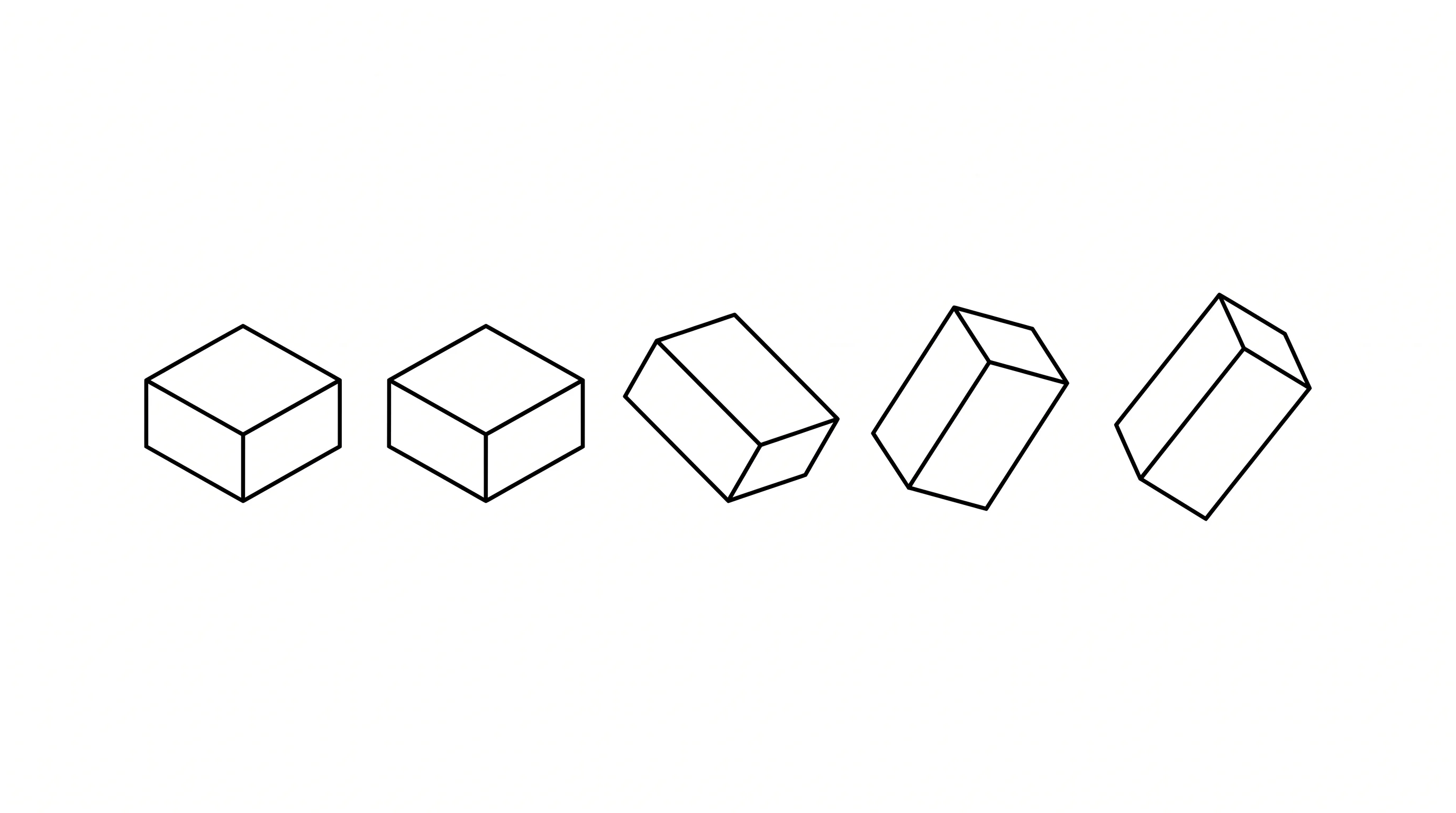
Take two shapes, one turned away from the other, and decide whether they are the same object or mirror images of it. There is nothing to look up and no way to talk yourself through it fast enough. You have to turn one of them.
The interesting part is what happens to the clock while you do it. The further apart the two shapes sit in angle, the longer you take, and it scales almost perfectly: twice the turn, twice the wait. Two psychologists at Stanford, Roger Shepard and Jacqueline Metzler, timed eight people through sixteen hundred of these puzzles each in 1971 and got a speed out of it. People turn an imaginary object at about sixty degrees a second, roughly six seconds for a full revolution, as though the thing had actual weight and had to come round.
That is visuospatial processing. This series treats thinking as a panel of twelve separate functions rather than one score, and this one holds the oddest position on it. It responds to practice better than anything else on the panel, and almost nobody is ever scored on it.

What It Actually Is
Working memory is the RAM and processing speed is the clock. Visuospatial processing is the graphics card: the part built to hold a whole scene and move it around as one piece, instead of working through it detail by detail. Packing a boot that is slightly too small. Reversing into a tight parking space. Reading a map while facing south. Knowing the sofa will not make the turn on the stairs before you carry it up there. The sofa and the map are the same operation.
On the standard map of mental abilitiesstandard map of mental abilitiesThe Cattell-Horn-Carroll model, the mainstream taxonomy of cognitive abilities. Visuospatial processing appears there as Gv, visual processing: a broad ability covering perceiving, holding, and mentally transforming visual and spatial information, sitting beside fluid reasoning rather than underneath it. this has its own territory, sitting next to reasoning rather than under it. That placement is why this article exists. Spatial skill and reasoning skill travel together loosely, the way most mental abilities do, but they come apart often enough that collapsing them into one number throws away something real about a person.
The wiring runs along the back and top of the head. Signal leaves the visual cortex on two routes. One drops into the temporal lobe and works out what you are looking at. The other climbs into the parietal lobeclimbs into the parietal lobeThe dorsal visual pathway: the route running from the occipital lobe up into the parietal cortex, carrying where an object is and how to act on it. Its counterpart, the ventral pathway, carries what the object is. and works out where it is and what your hands should do about it. The second route is the one this article is about.
The cleanest evidence for the split is a patient known in the literature as DF, who lost the first route to carbon monoxide poisoning. Asked to say which way a slot in front of her was angled, she could not tell you. Handed a card and asked to post it through, she turned her wrist to the right angle and posted it first time. Her hands had information her speech could not reach.
The tidy version of that story has been argued over ever since. The two routes talk to each other constantly, and the parietal lobe is also busy with attention, arithmetic, and reaching. So the hardware metaphor takes the same caveat as the others in this series. Your head holds a region that happens to be good at this, not a component you could pull out and turn over in your hand.
The strongest sign that this is its own faculty comes from people who cannot picture anything at all. Ask them to bring an apple to mind and nothing arrives. The condition is called aphantasiaaphantasiaAphantasia: the absence of voluntary visual imagery, an inability to summon a mental picture on request. The term was coined by Zeman and colleagues in 2015., and you would expect it to wreck performance on a rotation test. It does not. In a 2024 study they came out slower than people with normal imagery, and more accurate. Losing the picture does not cost you the rotation. The seeing and the turning are two separate jobs.
How To Measure It Without Fooling Yourself
The tests are old and mostly good. The standard rotation test dates to 1978 and still uses Shepard and Metzler’s block figures. Elsewhere you might be asked to rebuild a pattern out of colored cubes, to copy an awkward line drawing and then redraw it from memory, or to say which way a folded sheet of paper would open out. In a clinic you may simply be asked to draw a clock face, which packs a lot of machinery into one cheap instruction.
Each of them is easy to misread, in four ways worth knowing about. Call them traps.
The first is that people solve these differently. The test is named after rotation, and a good fraction of takers never rotate anything. When researchers sorted nearly seventeen hundred students by how they had actually worked the items, several distinct groups fell out. One of them never turns the shape at all. Those takers leave it where it is and compare corners, count blocks, and rule out the wrong answers instead. Mary Hegarty, who studies how people think about space, had takers narrate as they went, and most of us turn out to switch between methods rather than commit to one. Two identical scores can come from two completely different pieces of mental work, and the score does not record which.
The second is the stopwatch. A time limit does not merely make the test harder, it changes what the test is measuring. Run the same rotation items under a tight clock and the average gap between men and women grows. Give people longer and it shrinks, in proportion to how much time you allow. Same items, same people, different answer depending on the timer. A spatial score that does not tell you its time limit has not told you much.
The third is that most of these tests run through your hands and eyes. Rebuilding a cube pattern needs steady fingers. Copying a drawing needs you to be able to draw. Take two people with equally good spatial ability and the one who sees less well will score worse on the copying task, purely because of the eyes. In an older adult a bad result can be a tremor, a cataract, or an arthritic thumb, with the spatial machinery working perfectly well.
The fourth is that spatial ability is not one thing, and nobody has settled how many things it is. Turning a shape, judging a distance, and picturing an object unfolded come apart when you measure them. The most thorough survey of the evidence ever assembled could not cleanly separate two of the main candidates from each other. A single spatial score is an average over parts that do not move together.
That fourth trap bears directly on the one thing everybody knows about these tests. Mental rotation carries the largest and most repeated average gap between men and women in the whole cognitive literature. It is also the measure most sensitive to the timer, the shapes you pick, and the method the taker brings, none of which is ability. The two groups overlap so heavily that most men and most women score in the same range. Knowing someone’s sex tells you almost nothing about their score. Report the time limit and the shapes alongside the number, or the number will not compare to anyone else’s.
How It Drifts
You do not arrive with this fully built. Studies of infants find barely any difference between one baby and the next. The gaps that later get argued about open up during the school years and widen through the teens, which puts much of the construction inside the years someone is being taught.
Adulthood is where the honest answer gets awkward. Line up people of different ages and compare them, and spatial scores look like they start sliding in your twenties. Follow the same people for decades instead, and no reliable decline turns up until around sixty. Warner Schaie ran that second kind of study in Seattle for most of his career, and it is the standing correction to the gloomy version: inside one person the slide starts later and runs gentler than the snapshot suggests. Both pictures are true. They answer different questions.
The reason to keep an eye on this one is what its failures tell you. When this function goes wrong, it helps narrow down which problem you have, rather than only reporting that you have one.
Everybody expects memory to go first. In ordinary Alzheimer’s disease it does, which is why memory dominates every conversation about screening. In dementia with Lewy bodiesdementia with Lewy bodiesDementia with Lewy bodies: the second most common degenerative dementia after Alzheimer’s, caused by protein deposits called Lewy bodies. Attention, alertness and visuospatial skill are hit early, and visual hallucinations are common. the order flips. Researchers looked at cases confirmed after death and counted who had struggled with copying and assembling shapes. Around three quarters of the Lewy body patients had, against under half of the Alzheimer’s ones, and their memory was comparatively intact. Parkinson’s often runs the same way. And there is a version of Alzheimer’s that starts at the back of the brainversion of Alzheimer’s that starts at the back of the brainPosterior cortical atrophy: a presentation of Alzheimer’s disease in which degeneration begins at the back of the brain, so visual and spatial processing fail first while memory stays relatively intact early on., where what fails first is not remembering but making sense of what the eyes are sending. People with it often work through several opticians before anyone thinks to involve a neurologist.
Hence the clock face, and the pair of overlapping five-sided shapes a patient is asked to copy exactly. Both pack a lot of machinery into one cheap instruction, which is why they survive at the bedside. They are also screening tools rather than diagnoses, and how accurate they look depends on which scoring scheme you use. One common method catches more of the people who are ill. Another is better at not alarming the people who are not. False alarms cluster in people with less formal schooling.
The most interesting recent work uses navigation instead of paper. A research team built a mobile game, gathered a benchmark from tens of thousands of players, then compared people carrying a gene variant that raises Alzheimer’s risk against people without it. Everyone in the comparison was cognitively healthy. One measure of how efficiently people found their way separated the two groups. A standard memory test, given to the same people, did not.
That deserves saying carefully, because it gets retold badly. The laboratory group was sixty people, which is small for a claim this size. Carrying the variant is not having the disease, and well under half of carriers ever develop symptoms. The authors were explicit that they were hunting for an early signal, not proposing a test. What it suggests is that if such a signal exists, this function may be where it shows up first.
The claim you will meet far more often, that satellite navigation is eroding your sense of direction, is much thinner than its circulation suggests. The main study compared fifty drivers at a single point in time, and its follow-up tracked just thirteen of them, which is far too few to build anything on. Nobody has run the experiment that would tell you whether the GPS causes the difference or whether people who navigate badly reach for it more often.
Run It On Yourself
You can get a usable reading at home, and the kit is pleasingly low-tech. The redrawn rotation test and the paper-folding test have both been circulating for decades and are what the research actually runs on. Print one, sit it properly, and you have something closer to a measurement than an app will give you.
Two of the four traps above are yours to control at a kitchen table. Fix the time limit and write it down, because a sitting with no clock cannot be compared against published scores collected under one. Note how you actually solved the items, since switching method between sittings will move your score without moving your ability. The other two, the hands-and-eyes problem and the question of which slice of spatial ability you happen to be sampling, you cannot fix at home. You can only decline to over-read a single number because of them.
Then there is practice, which the last section did not cover. Sit a test like this a second time and somebody who started out dead average would score well enough to beat about sixty-three people in a hundred, with no change in ability whatsoever. A third sitting takes them to about seventy in a hundred. A fourth adds nothing you could tell apart from zero. Your first few numbers are largely measuring how used to the format you are, so leave real time between attempts.

Read the result as a rough position rather than a verdict. One sitting tells you approximately where you sit. Several sittings under identical conditions, months apart, tell you the more useful thing, which is whether anything is moving.
What You Can Actually Do About It
One distinction decides this section, and most bad versions of the conversation ignore it. Getting better at things that resemble what you practiced is one question, and researchers call it near transfernear transferNear transfer: improvement on tasks closely resembling the one you trained on. Routinely found in training studies and far easier to produce than far transfer.. Getting better at something distant, the school subject or the job, is far transferfar transferFar transfer: improvement on something distant from the trained task, such as school achievement or job performance. Across cognitive training research it is rarely demonstrated., and it is a different question with a different answer. Results from the first get quoted to settle the second constantly.
On the first question, spatial practice genuinely works. David Uttal and colleagues pooled around two hundred training studies and found a solid improvement that lasted and that showed up even on spatial tasks nobody had practiced. Brain-training studies aimed at memory and reasoning have repeatedly failed to produce that kind of lasting, spreading gain, so this is a different order of result, and it has held up.
Read the same review more carefully and it cools off. The people who trained improved. So did the control groups, who did nothing but take the test a second time, by almost as much. So a large share of what looks like training is just people getting comfortable with the format. That is the same inflation the last section warned about, except here it is contaminating the evidence that training works.

On the second question it comes apart. Two of the researchers behind that review went looking for studies showing spatial training lifting real academic results, and found six in thirty years. All six found something, none of it large, and their own verdict was that funding big programs on this evidence would be premature. A later review did find spatial training nudging mathematics performance by a modest amount, which is the most encouraging result in the area. Meanwhile researchers surveying cognitive training across every domain put distant transfer at roughly nothing. The skill improves and the benefit does not reliably travel with it. That last group is not even arguing with the first. They cite Uttal approvingly, as a good example of the near kind.
The best real-world evidence comes out of a university rather than a laboratory. Sheryl Sorby, an engineering professor, has run a spatial-skills course since the early nineties for students who fail a spatial screening test. The study to read is the later one, which compared students who landed just either side of the pass mark. That is about as close to a controlled experiment as a university course gets, and it found better grades in introductory courses and better odds of finishing the degree. A term-long course inside a real curriculum, not a game and not an app.
So the trainability claim is narrower than the one I opened with. The spatial skill itself moves, and more convincingly than memory or reasoning ever have under training. Whether moving it buys you anything elsewhere is mostly unproven.
If you want to work on it anyway, the closest thing to evidence-backed is doing the real activity at length. Build things with your hands. Draw the thing you are trying to understand instead of describing it. Walk somewhere new with the directions switched off. The evidence thins the further you drift from the actual task, and the spatial-training apps sit at the far end of that drift.
The larger opportunity, though, is not training. It is measurement.
A survey of about four hundred thousand American high school students, followed for eleven years, gave Jonathan Wai and colleagues something to go back through. They found that a teenager’s spatial score helped predict who ended up with a science or engineering degree and career. It did so even after their math and verbal scores had already been taken into account, so it was carrying information those two had missed. Then they looked at the students in the top one percent for spatial ability. About seventy percent of them were not in the top one percent for math or verbal. Any talent search built on the usual two scores misses most of them by design.

That is a strange thing to leave lying around. Here is a well-mapped mental faculty, with cheap paper tests, decades of evidence that it predicts where people end up, and essentially no institution that measures it. Nobody gets a spatial score on a report card.
The Component Nobody Benchmarks
Some of that is history. Spatial tests do not fit an exam hall, they do not scale into a syllabus, and the one large sex difference attached to them made the area awkward to teach for a long stretch. None of which is a reason for the function to be missing from the panel. The cost of leaving it out does not fall evenly. It lands on the students whose strongest component is the one nobody scores, which is precisely the group those Project TALENT numbers describe.
If you are running yourself as a system, the practical version is small. Get a baseline with a real instrument, hold the conditions steady, and watch it the way you watch anything else you care about. Of all the functions in this series, this is the one you are most likely never to have measured once.
References
Shepard, R.N. & Metzler, J. (1971). Mental Rotation of Three-Dimensional Objects.
Response time rises linearly with angular disparity, implying a mental rotation rate of roughly 60 degrees per second.
Vandenberg, S.G. & Kuse, A.R. (1978). Mental Rotations, a Group Test of Three-Dimensional Spatial Visualization.
The standard paper-and-pencil rotation test, built from Shepard and Metzler’s figures.
Peters, M. et al. (1995). A Redrawn Vandenberg and Kuse Mental Rotations Test.
The redrawn version in general research use, produced after the original stencils degraded.
Goodale, M.A. & Milner, A.D. (1992). Separate Visual Pathways for Perception and Action.
Recasts the dorsal stream as how rather than where, on the evidence of patient DF.
de Haan, E.H.F. & Cowey, A. (2011). On the Usefulness of What and Where Pathways in Vision.
Argues the two-stream dichotomy is too rigid and proposes an interactive alternative.
Zeman, A., Dewar, M. & Della Sala, S. (2015). Lives Without Imagery: Congenital Aphantasia.
The case series that named aphantasia.
Kay, L., Keogh, R. & Pearson, J. (2024). Slower but More Accurate Mental Rotation Performance in Aphantasia.
People without voluntary imagery still perform mental rotation, with a different speed-accuracy profile.
Geiser, C., Lehmann, W. & Eid, M. (2006). Separating Rotators From Nonrotators in the Mental Rotations Test.
Latent class analysis on 1,695 students finds distinct solution strategies behind the same test.
Hegarty, M. (2018). Ability and Sex Differences in Spatial Thinking: What Does the Mental Rotation Test Really Measure?
Verbal protocols show mixed strategies, with the global-shape approach correlated with accuracy.
Voyer, D. (2011). Time Limits and Gender Differences on Paper-and-Pencil Tests of Mental Rotation.
The apparent sex difference scales with the time limit imposed.
Linn, M.C. & Petersen, A.C. (1985). Emergence and Characterization of Sex Differences in Spatial Ability.
Splits spatial ability into perception, rotation, and visualization, which behave differently.
Voyer, D., Voyer, S. & Bryden, M.P. (1995). Magnitude of Sex Differences in Spatial Abilities.
Smaller effect sizes than earlier work, varying by instrument and administration.
Coates, D.R., Wagemans, J. & Sayim, B. (2017). Diagnosing the Periphery: Using the Rey-Osterrieth Complex Figure Drawing Test.
Reduced visual input degrades Rey figure performance independent of spatial ability.
Scharfen, J., Peters, J.M. & Holling, H. (2018). Retest Effects in Cognitive Ability Tests.
Figural tests inflate about 0.32 SD from first to second sitting and 0.52 SD by the third.
Lauer, J.E., Yhang, E. & Lourenco, S.F. (2019). The Development of Gender Differences in Spatial Reasoning.
Across 30,613 children, the rotation gap emerges in childhood and grows through adolescence.
Salthouse, T.A. (2009). When Does Age-Related Cognitive Decline Begin?
Cross-sectional spatial visualization falls from the twenties, about 1 SD between 18 and 60.
Schaie, K.W. (1994). The Course of Adult Intellectual Development.
Within-person decrement is not reliably found before 60, though it reaches every ability by 67.
Tiraboschi, P. et al. (2006). What Best Differentiates Lewy Body From Alzheimer’s Disease in Early-Stage Dementia?
Visuospatial and constructional impairment in 74 percent of autopsy-confirmed Lewy body cases against 45 percent of Alzheimer’s.
Crutch, S.J. et al. (2017). Consensus Classification of Posterior Cortical Atrophy.
Diagnostic criteria for the posterior-first presentation, where visual and spatial function fail before memory.
Litvan, I. et al. (2012). MDS Task Force Guidelines for Mild Cognitive Impairment in Parkinson’s Disease.
The diagnostic framework in which non-amnestic impairment is the most common Parkinson’s profile.
Park, J. et al. (2018). The Clock Drawing Test: A Systematic Review and Meta-Analysis of Diagnostic Accuracy.
Pooled accuracy across 5,531 participants, varying substantially by scoring system.
Coutrot, A. et al. (2018). Global Determinants of Navigation Ability.
Navigation performance across millions of players declines steadily with age from the late teens.
Coughlan, G. et al. (2019). Toward Personalized Cognitive Diagnostics of At-Genetic-Risk Alzheimer’s Disease.
A wayfinding measure separated genetic-risk carriers from non-carriers where a memory test did not.
Dahmani, L. & Bohbot, V.D. (2020). Habitual Use of GPS Negatively Impacts Spatial Memory.
A cross-sectional association in 50 drivers, with a 13-person longitudinal follow-up.
Uttal, D.H. et al. (2013). The Malleability of Spatial Skills: A Meta-Analysis of Training Studies.
Training improves spatial skills by g = 0.47, durably, though control groups also gain 0.45 on retest alone.
Stieff, M. & Uttal, D. (2015). How Much Can Spatial Training Improve STEM Achievement?
Only six studies in thirty years tested transfer to real achievement; the authors judge the evidence inadequate.
Hawes, Z.C.K., Gilligan-Lee, K.A. & Mix, K.S. (2022). Effects of Spatial Training on Mathematics Performance.
Spatial training transfers to mathematics at g = 0.28, with control type not moderating the effect.
Sala, G. & Gobet, F. (2023). Cognitive Training: A Field in Search of a Phenomenon.
Near transfer is real across domains; far transfer sits near zero.
Wai, J., Lubinski, D. & Benbow, C.P. (2009). Spatial Ability for STEM Domains.
Across 400,000 students, spatial ability predicts STEM outcomes beyond math and verbal scores.
Kell, H.J. et al. (2013). Creativity and Technical Innovation: Spatial Ability’s Unique Role.
In a separate cohort, spatial ability adds 7.6 percent of variance in patents and publications decades later.
Sorby, S., Veurink, N. & Streiner, S. (2018). Does Spatial Skills Instruction Improve STEM Outcomes? The Answer Is Yes.
A cutoff-based design finds spatial instruction affects introductory STEM grades and retention.
Dindin, M. (2026). Hold That Thought.
Working memory, the mind’s RAM.
Dindin, M. (2026). Clock Speed.
Processing speed, the clock every other function runs on.
Dindin, M. (2026). Raw Compute.
Fluid reasoning, and why training does not raise it.
Dindin, M. (2026). Not One Number.
Why cognition is a panel of separate functions, not a single intelligence number.